Project Ariel — Low-Altitude Aerial Detection
ML Engineering · Group-One · THD × THI × Fraunhofer IVI · April – July 2026
YOLOv8n · 2× speed · conf=0.50
Problem
Existing aerial object-detection datasets — VisDrone, UAVDT — are designed for flight altitudes above 30 metres. At 3–9 metres the geometry changes entirely: objects fill the frame, perspective distortion dominates, and ground shadows frequently exceed the physical footprint of the objects they cast. Standard detectors miss detections and generate high false-positive rates on shadows and ground texture.
The project's goal was to close that gap by building a fully annotated dataset from real low-altitude drone footage and fine-tuning a nano-scale model suitable for onboard edge deployment.
4-Stage Pipeline
Frame Extraction
30 FPS drone footage filtered with a pixel-wise intensity threshold (≥10% delta per frame). Reduces 2,374 raw frames to ~237 per video sequence without sacrificing scene diversity.
Annotation
Collaborative labeling in Roboflow: tight bounding boxes, shadow exclusion (label the physical silhouette only), ≥20% body-visibility rule for truncated objects, ~15% negative-sample ratio.
Training
YOLOv8n on Google Colab T4 GPU for 150 epochs. Cosine LR decay, early stopping (patience=15), tuned loss weights (box=7.5, cls=1.5), batch=16, imgsz=640.
Evaluation
Locked 10% test split — 231 images, 501 instances. Metrics: mAP@0.5, mAP@0.5:0.95, per-class precision and recall, and confusion matrix analysis.
Dataset
Classes: Human 3,642 (76.2%) · Bicycle 597 (12.5%) · Vehicle 537 (11.2%) · Scenes: DK_backyard, DK_parking, THI_Bikepark, THI_Grass · Split: 80 / 10 / 10
Results
| Class | Precision | Recall | mAP@0.5 | mAP@0.5:0.95 |
|---|---|---|---|---|
| All | 0.956 | 0.926 | 0.918 | 0.850 |
| Human | 0.949 | 0.958 | 0.951 | 0.845 |
| Bicycle | 0.918 | 0.818 | 0.807 | 0.713 |
| Vehicle | 1.000 | 1.000 | 0.995 | 0.993 |
Inference Latency · T4 GPU
Key Finding
Confusion matrix analysis revealed the primary failure mode: 83% of background false positives were classified as Human. The model occasionally hallucinates people on empty terrain — a direct consequence of Human being the majority class (76.2%). Future iterations should expand the negative-sample pool and apply hard-negative mining to address this bias.
Team
Sample Predictions
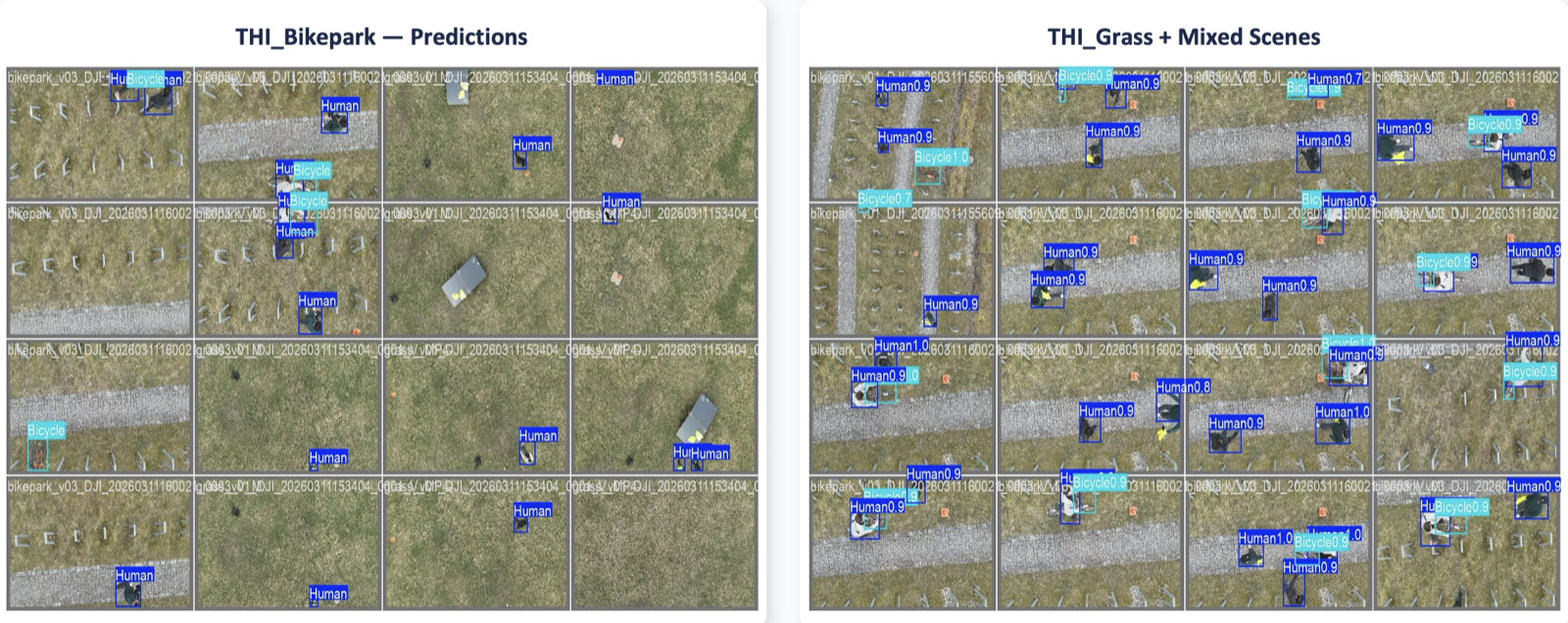
THI_Bikepark · THI_Grass + Mixed Scenes — model predictions
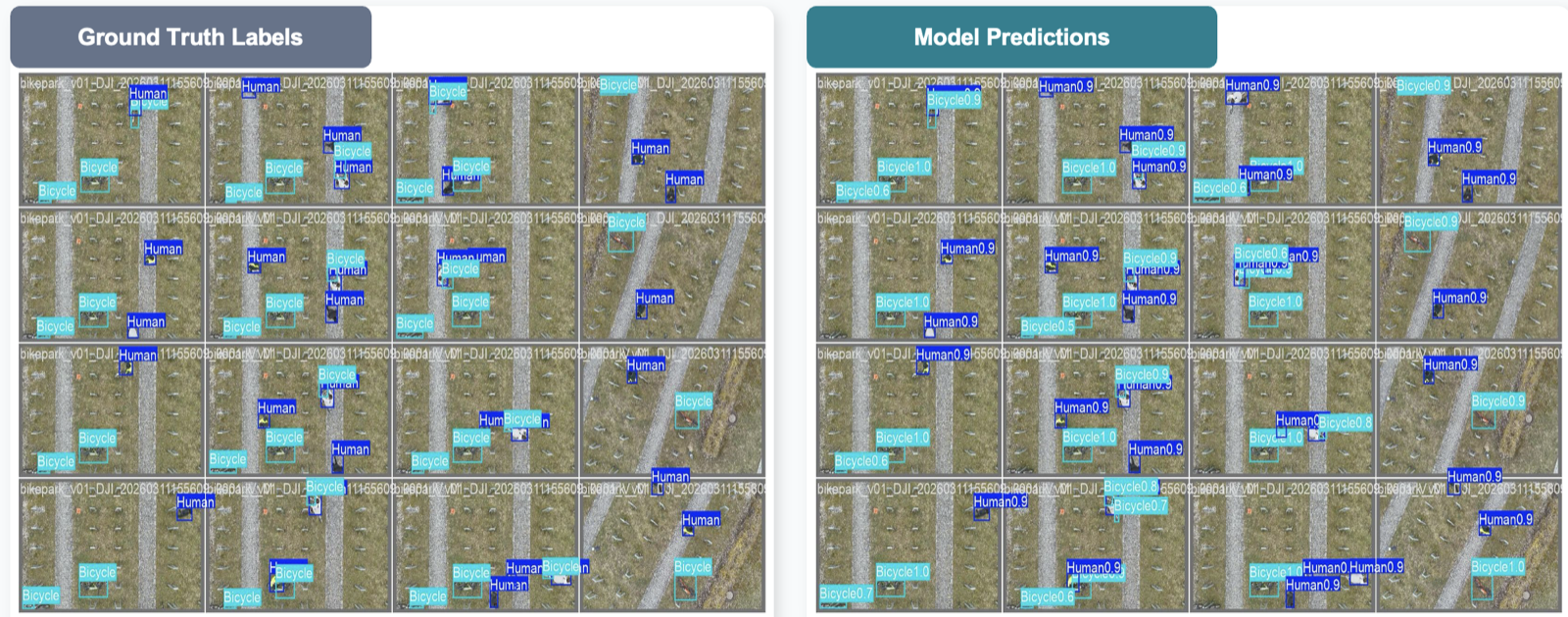
Ground Truth Labels vs Model Predictions — THI_Bikepark